A note from Joe
The Process
Arthur’s Working Notes marks my debut as a published author. It was not the first manuscript I tried to write.
Most of my effort went into refining ideas into a clear, functional form, rather than waiting for the ideas themselves to arrive.
This book means a great deal to me. I want to share some of the thoughts behind it: excerpts, notes, and screen grabs of the drafts.
I hope this page will also help me develop a better approach to the next book. I have a preferred style of writing. Keeping everything organised has been another matter.
I’ve switched between editors, misplaced notebook pages, and spread the manuscript across three different computers. Some of it was on my phone. A real noob way to write a book. By sharing these fragments, I hope to help someone else trying to write one, too.
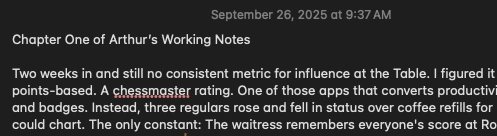
Trimming Arthur
Chapter 3 shows where much of my time went. I had the characters, the setting, and most of what I wanted to say. Turning that into a chapter took longer than getting it into a notebook.
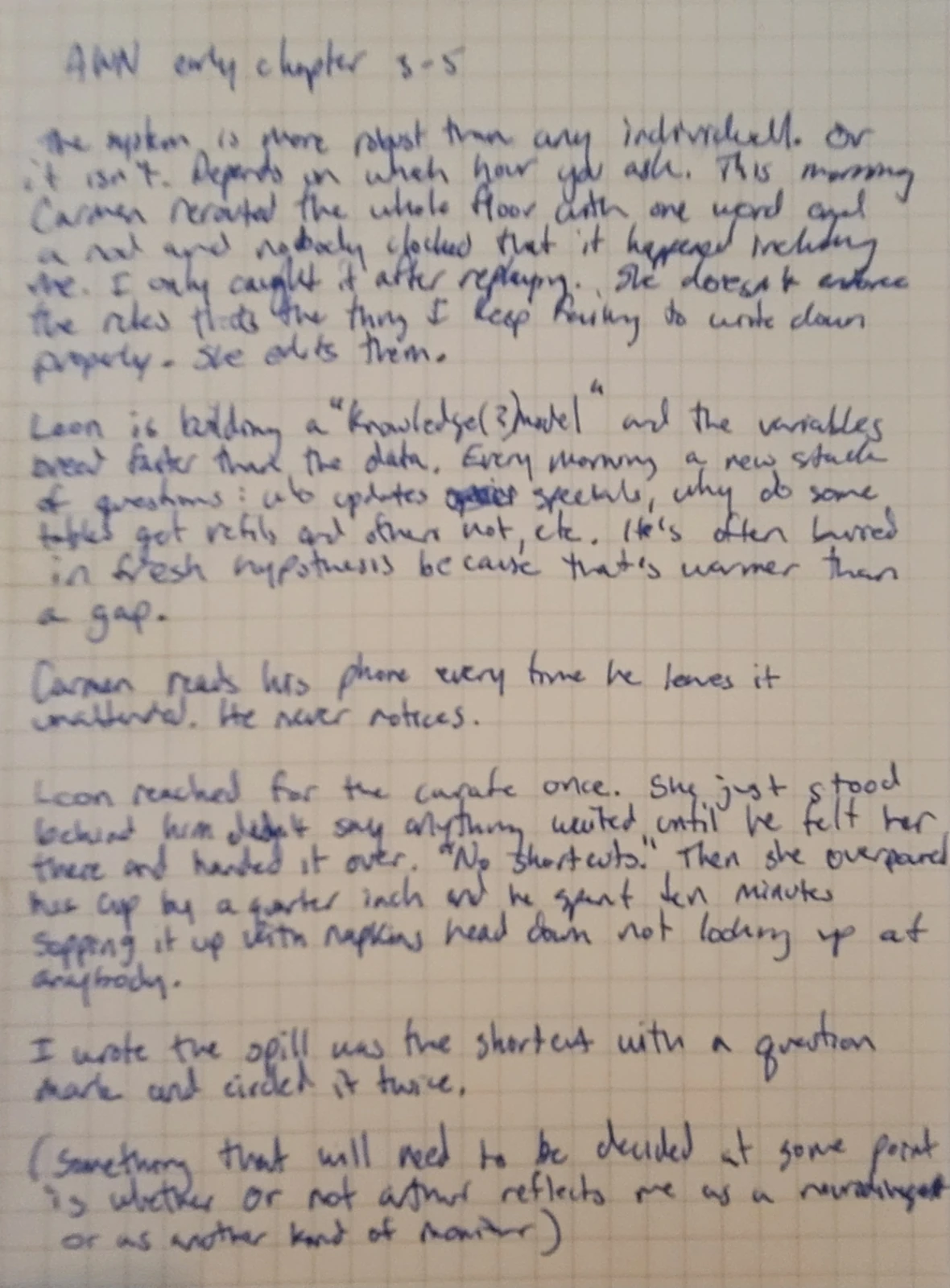
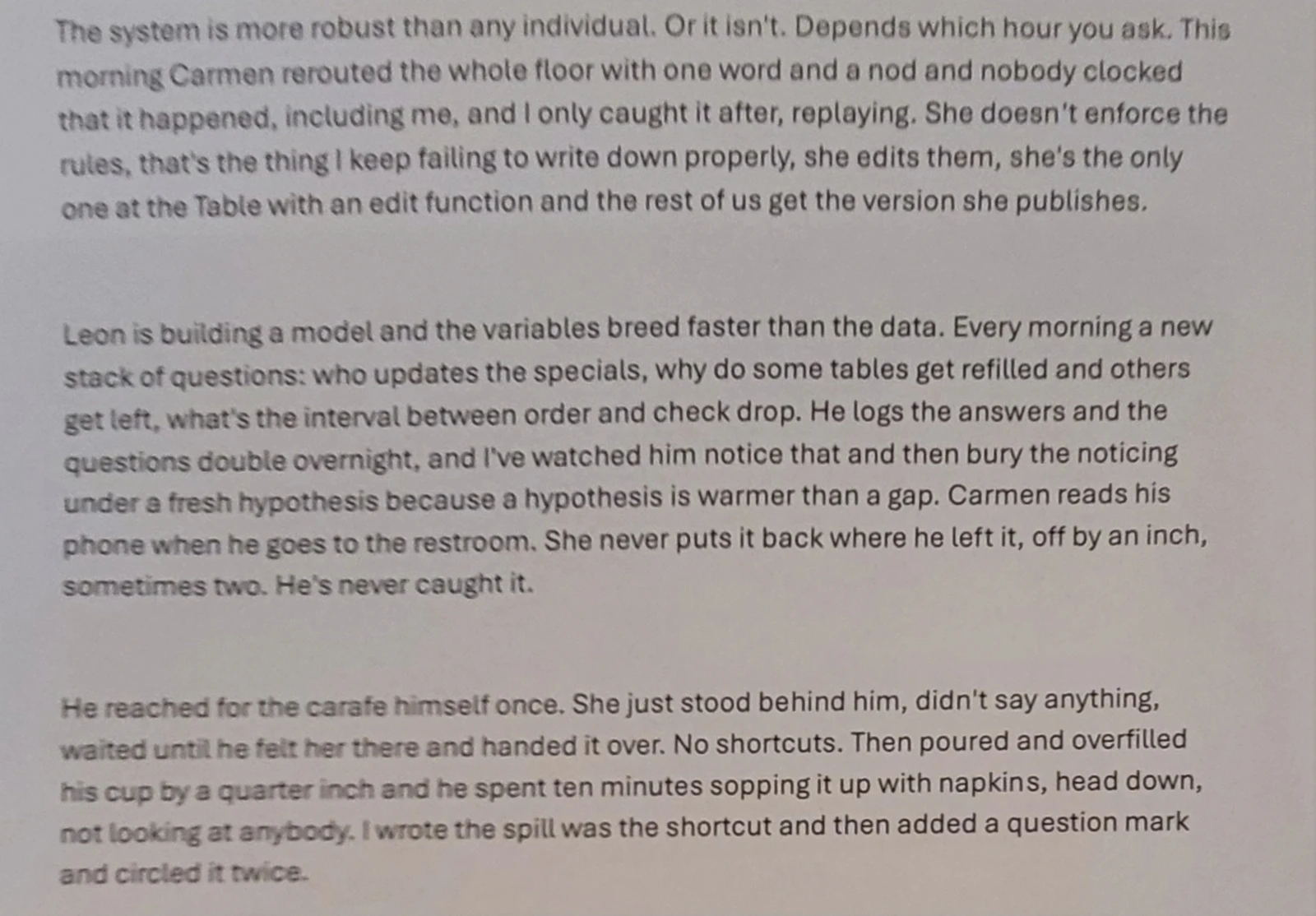
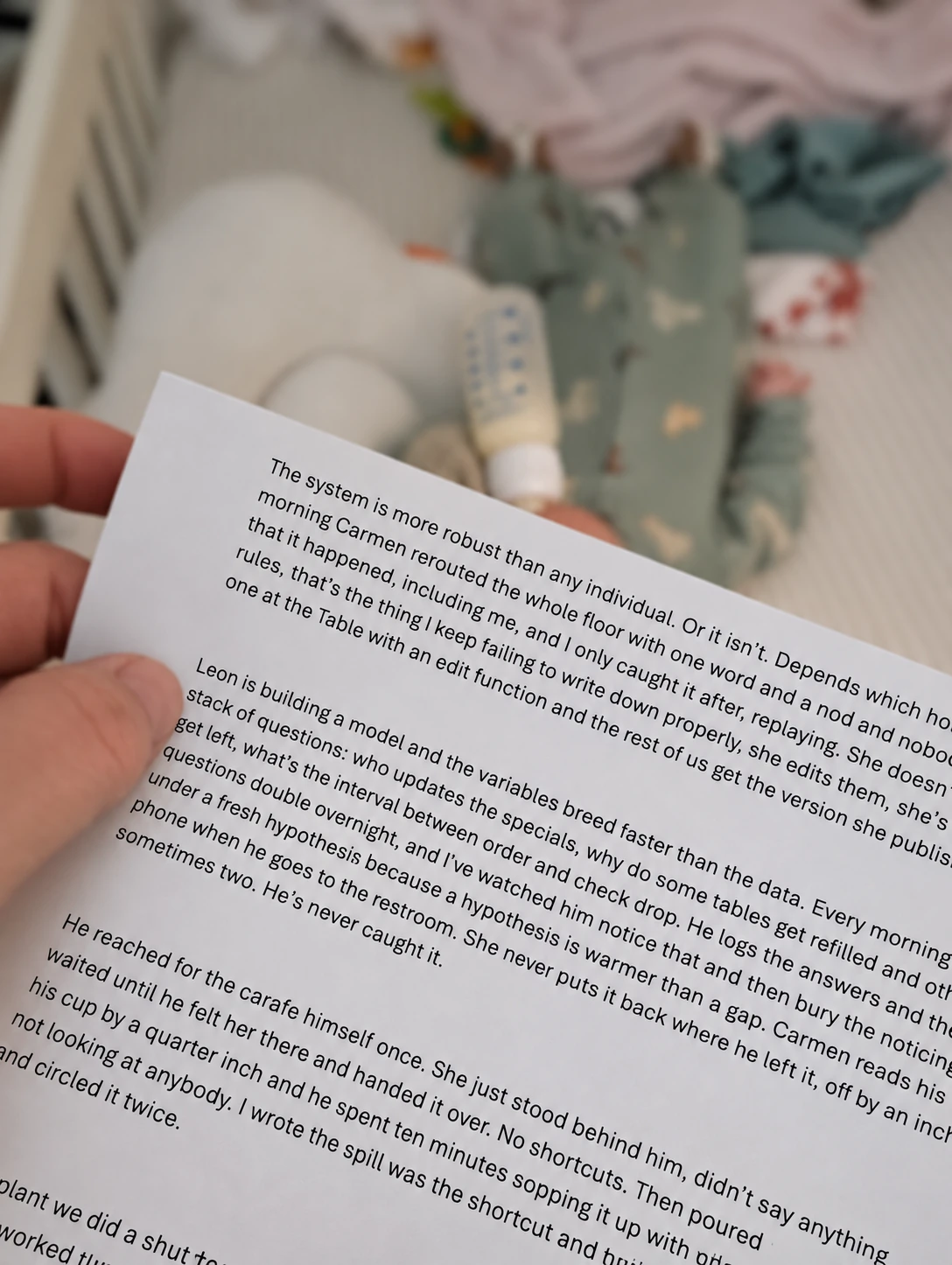
The handwriting came first. Those notes became the printed draft shown in the next two photographs. That draft went through further revisions to become the book copy, which is not pictured here. I’ve included a few short passages from Chapter 3 below so you can compare the versions.
Getting the idea down
In the early drafts, I called the Rule Collector Leon. I knew his name, so I used it without much thought. Arthur does not know it yet. In the chapter, he has to remain the Rule Collector. It was a small correction, but it mattered. I was writing what Arthur could know, not everything I knew about the people at his table.
The notebook let me explore a thought for as long as I needed. Sentences would begin, pause for an explanation, and then start again. That helped me work through the ideas. Not all of it needed to come with me into the chapter.
Taking the words off the mug
One version opened with “No shortcuts” written on a mug. I liked the phrase, but the mug was explaining the chapter before anyone had done anything.
The words stayed. They became something Carmen says after the Rule Collector reaches for the carafe himself. She stands behind him and waits until he notices her and hands it over. Then she says “No shortcuts” and pours, overfilling his cup.
That gave the line a reason to be there. You see their interaction rather than being handed a catchphrase at the beginning.
What made it into the book
The photographs stop at the printed draft. These are passages from the book copy. You can compare them with the handwriting and print above.
She does not enforce the rules. She edits them.
The long sentence in the draft became these two sentences. I had clarified what Arthur meant and could take out the part where he was still trying to say it.
Carmen sometimes reviews his notes when he goes to the restroom. She never puts the phone back exactly where he left it.
The phone is still out of place. The measurements and “He’s never caught it” are gone. I wanted to leave you room to notice what Carmen was doing.
Once, when the Rule Collector reached for the carafe himself, Carmen paused behind him, silent, until he noticed and handed it over. She said, “No shortcuts,” then poured, overfilling his cup.
By the book copy, he is the Rule Collector rather than Leon. Carmen’s pause, his handing over the carafe, and her words are all part of the same incident.
Letting Arthur finish a sentence
The draft says, “She doesn’t enforce the rules, that’s the thing I keep failing to write down properly, she edits them.” I had needed all of that to find the thought. The chapter only needed: “She does not enforce the rules. She edits them.”
I made similar cuts around the measurements. The draft has inches, seconds, and ounces. Arthur notices those things, but too many of them made the paragraph harder to follow. “She never puts the phone back exactly where he left it” kept what mattered about the misplaced phone without making you measure the gap.
I also took out “He’s never caught it.” I liked the beat, but I was explaining a joke that was already there.
Clarifying the timeline
A lot of the notebook is in the present tense. It feels natural when I am getting a scene down, but carried straight into the chapter it made every observation sound equally urgent.
The chapter keeps the present for things Arthur has come to expect: “She does not enforce the rules.” It moves into the past for a particular incident: “Once, when the Rule Collector reached for the carafe…” That helped me separate the usual diner routine from what happened on one particular day.
Not every word I questioned needed replacing. I had been thinking that “questions” should replace “variables.” In the end, both stayed in different sentences. The Rule Collector builds his model and the variables multiply. His questions keep breeding too. They were doing different jobs.
Knowing when to stop cutting
I went too far with the daughter’s photo. I shortened the line to “My daughter sent a photo.” It saved a few words and lost something important. “My daughter sent me a photo of her at her new job” sounds like Arthur receiving something from his daughter, rather than reporting that a photo exists.
Her caption, “I stole your move,” stayed as well. I had marked it to go because I thought it explained too much. Reading it again, I wanted that moment between them. He tapes the photo over the old factory phone list inside his notebook and writes, “I cannot decide if this is an upgrade.”
Some of the shortest lines had been right from the start. “Close enough.” Then Arthur’s “She was right.” I did not need to improve those. I needed to put quotation marks around the spoken words and leave them alone.
There is also a place where Arthur writes, “I scratched out the last sentence. Too obvious.” I kept the sentence and the scratch. His second thoughts belong in the book too.
Leaving him in the room
The draft ended with Arthur watching the reflection and then walking home. The walk finished his day, but it took him out of the room just when I wanted to stay there.
So Carmen stacks chairs. Marcus dims the lights and checks the locks. The Rule Collector stays outside in the glow of his phone. The chapter ends on the reflection.
Looking back through these pages, I can see how much of the writing was already in place and how much I was still trying to clarify for myself. I did not need to start the chapter again. I needed to read it closely enough to tell the difference.
Giving Arthur his own voice
Readers may wonder whether Arthur is neurodivergent, perhaps autistic, or whether some of his habits suggest OCD. There is plenty there to invite those questions, and I welcome the ambiguity. People who know me will recognise parts of me in the writing. But Arthur is not me. I needed to step back and give him the book, let him speak for himself, and let him be someone distinct from me. If nothing else, in Part Two I offer some thoughts of my own.
What I want to do differently
Putting these pages together brought up another lesson. I never settled on one writing process for this book. Drafts ended up in different editors, on different computers, in notebooks, and on my phone. What I can share now is fragmentary, and sometimes confusing. I have to identify which version I am looking at before I can explain what changed.
I could have made better use of something as ordinary as OneDrive or Google Drive. Keeping the drafts together, with a revision history, would have made it easier to follow a sentence from one version to the next. That would have helped with editing too, instead of leaving me to piece the changes together afterward.
I also think there is value in showing that history to a reader. With so much AI-generated writing around, being able to look back through the actual revisions matters to me. I would rather show how a passage developed than just say I spent time on it.
For future books, I will be making a deliberate effort to keep the work easier to follow and manage. That includes paying attention to burnout, doing more of the writing by hand, and making room to relax while I write. I want to keep the way I like to write without making it so difficult to find everything afterward.
That is part of why I want to share these fragments. They show some of what went into Arthur, but they also show me what I want to improve in the next book. Perhaps they will be useful to someone else working on their own.